


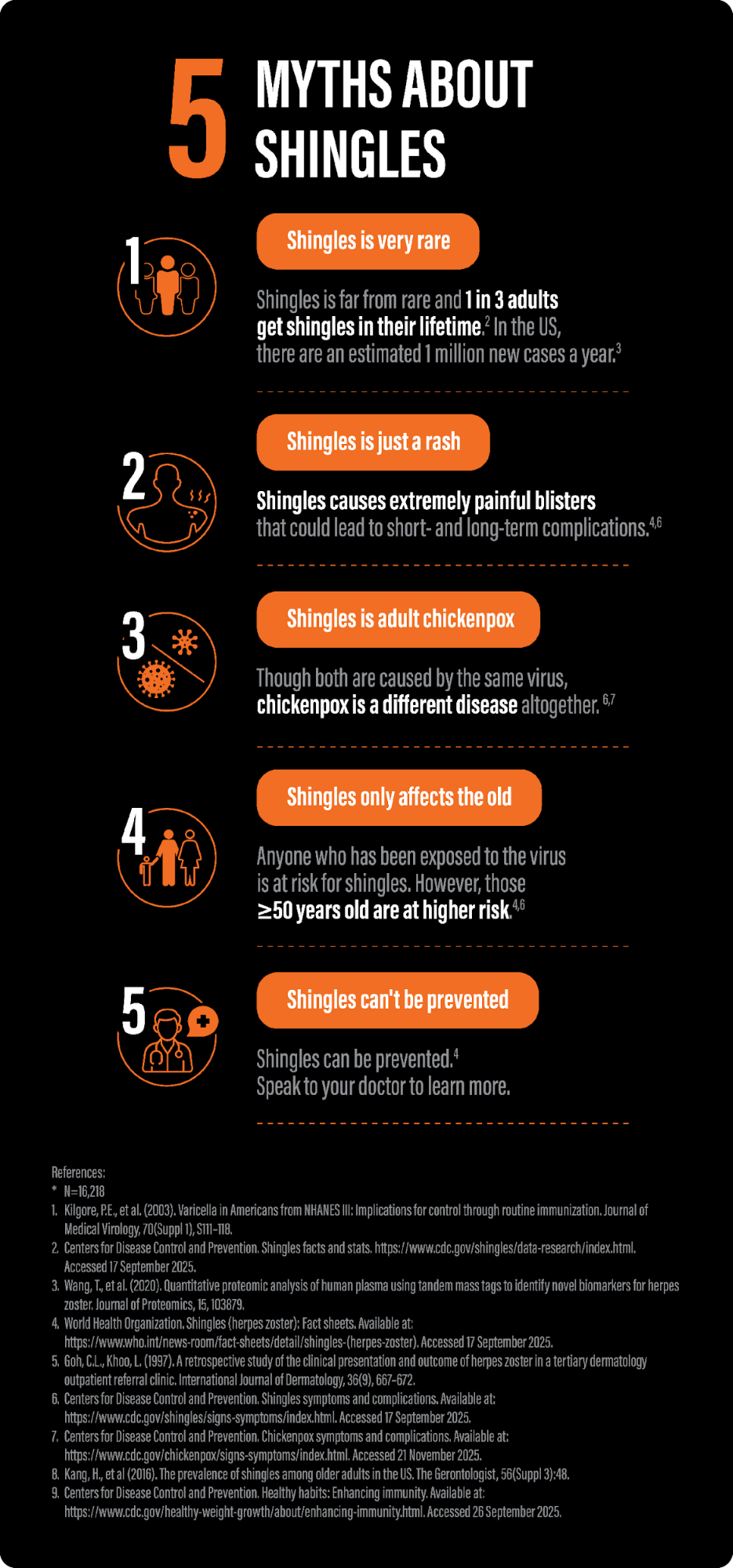
Myth 1: Shingles is very rare
Fact: 9 in 10 adults aged ≥50 years old have been exposed to the chickenpox virus that causes shingles. 1* This translates to 1 in 3 adults developing shingles in their lifetime,2* and an estimated 1 million new cases per year.3* Find out more about who is at risk of shingles.
*Based on US population data
Myth 2: Shingles is not too bad because it’s just a rash
Fact: Shingles isn’t just a rash. It is a viral disease that typically manifests as a band of blisters over the affected site.2 On top of these blisters, it is the pain that can make shingles excruciating—often described as “burning,” “throbbing,” or “stabbing” sensation.4 The pain can be severe enough to elicit feelings of helplessness, limit movement, cause sleep disturbance and work disruption.5
Shingles can also cause various short- and long-term complications, such as persistent nerve pain at the affected site, vision impairment if it affects the eyes, skin scarring, secondary infection of the blisters and stroke.4 Find out more about the impact of shingles.
Myth 3: Shingles is adult chickenpox
Fact: Though shingles is caused by the same virus causing chickenpox, it is a completely different disease.6,7 Chickenpox usually lasts about 4–7 days and rarely causes complications in healthy people.7 Also, the blisters in chickenpox are spread all over the body.7
Shingles, which results from the reactivation of the chickenpox virus, is often very painful.4,6 It affects the nerves of the affected area and can lead to a variety of short- and long-term complications, such as persistent nerve pain (post-herpetic neuralgia or PHN), that can last months to years.4,6 Read about shingles to find out more.
Myth 4: Shingles only affects the old
Fact: Although older individuals are at higher risk of getting shingles,4 anyone who has been exposed to the chickenpox virus is at risk.4,6 A study reported the lifetime risk of developing shingles for older adults is 13.5%, and this risk increases steadily with age.*8 In addition to age, read about the other risk factors for shingles.
Myth 5: Shingles can’t be prevented
Fact: Not true! Maintaining a healthy lifestyle (e.g., proper nutrition, regular exercise, sufficient sleep) can help support immune function and general health.9 Shingles is actually a vaccine-preventable disease.4 Learn more by reading about shingles prevention.
Speak to your doctor about shingles prevention.
* N=16,218
- Kilgore, P.E., et al. (2003). Varicella in Americans from NHANES III: Implications for control through routine immunization. Journal of Medical Virology, 70(Suppl 1), S111–118.
- Centers for Disease Control and Prevention. Shingles facts and stats. https://www.cdc.gov/shingles/data-research/index.html. Accessed 17 September 2025.
- Wang, T., et al. (2020). Quantitative proteomic analysis of human plasma using tandem mass tags to identify novel biomarkers for herpes zoster. Journal of Proteomics, 15, 103879.
- World Health Organization. Shingles (herpes zoster): Fact sheets. Available at: https://www.who.int/news-room/fact-sheets/detail/shingles-(herpes-zoster). Accessed 17 September 2025.
- Goh, C.L., Khoo, L. (1997). A retrospective study of the clinical presentation and outcome of herpes zoster in a tertiary dermatology outpatient referral clinic. International Journal of Dermatology, 36(9), 667–672.
- Centers for Disease Control and Prevention. Shingles symptoms and complications. Available at: https://www.cdc.gov/shingles/signs-symptoms/index.html. Accessed 17 September 2025.
- Centers for Disease Control and Prevention. Chickenpox symptoms and complications. Available at: https://www.cdc.gov/chickenpox/signs-symptoms/index.html. Accessed 21 November 2025.
- Kang, H., et al (2016). The prevalence of shingles among older adults in the US. The Gerontologist, 56(Suppl 3):48.
- Centers for Disease Control and Prevention. Healthy habits: Enhancing immunity. Available at: https://www.cdc.gov/healthy-weight-growth/about/enhancing-immunity.html. Accessed 26 September 2025.
- GSK is not responsible for third-party website content.