


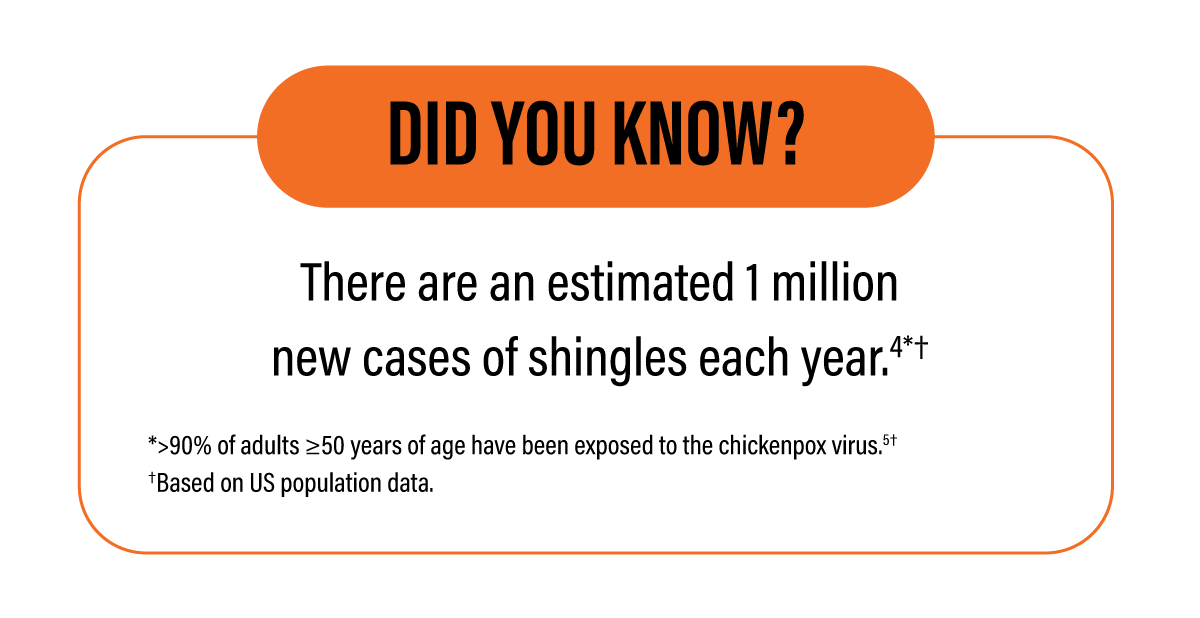
Shingles is caused by the reactivation of the chickenpox virus known as varicella-zoster virus.1 It is typically characterized by a painful, blistering rash that appears on one side of the body.1,2 Shingles most commonly occurs in patients ≥50 years of age, and the risk of shingles and related complications increases with age.1,3
If you think you are possibly experiencing symptoms of shingles, please consult your doctor as soon as possible so they can start treatment early.6 The available shingles treatments given by your doctor aim to address the sudden reactivation of the chickenpox virus (i.e., the viral infection) and the associated pain.1,2
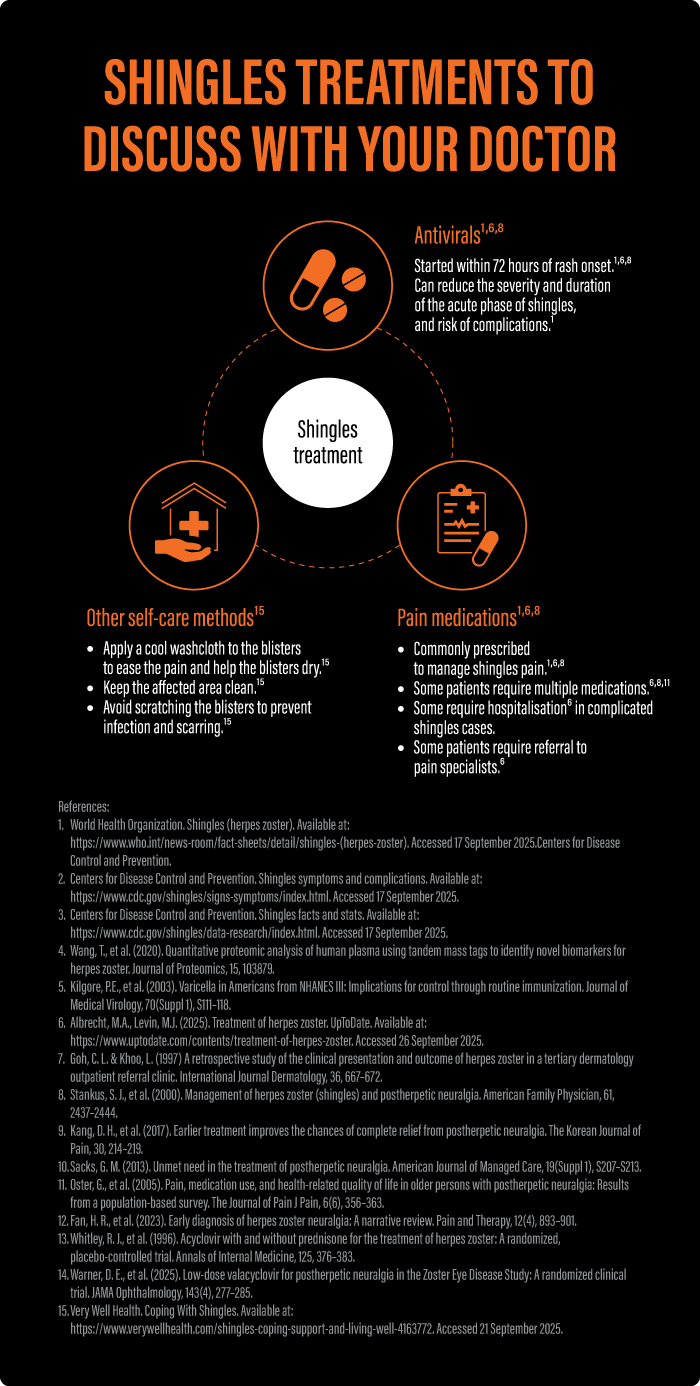
Antiviral medication
Antivirals are medications used to treat the virus causing the disease.1 They are used to decrease the severity and duration of the illness and reduce the risk of complications.1 If taken within the first 72 hours of having symptoms, these medications have been shown to reduce the time for the rash to heal and the severity and duration of the acute (immediate) pain from shingles.6 In a study conducted in Singapore, only 45%a of patients consulted a doctor within 3 days of symptom appearance.7
Pain medication
Pain medications are commonly prescribed by a doctor to manage the shingles pain and any persistent nerve pain or post-herpetic neuralgia (PHN).1,6,8 Examples of the types of pain medications that may be prescribed by your doctor include1,6,8:
- Simple analgesics – e.g., paracetamol and other non-steroidal anti-inflammatory drugs like ibuprofen
- Medications that have a sedative effect and offer some pain relief – e.g., tricyclic antidepressants
- Certain medications that are used to treat epilepsy, as these have shown to offer a reasonable relief for PHN
- Opioids
- Topical agents – e.g., pain patches and gels
Your doctor will advise you on the appropriate type of treatment depending on your situation.
If the pain is very severe or the response to pain medications is inadequate, you may be referred to a pain specialist or admitted to the hospital for pain management.6 Early referral to a pain specialist for the treatment of uncontrolled shingles pain or PHN could be beneficial.8,9
Challenges to the treatment of shingles
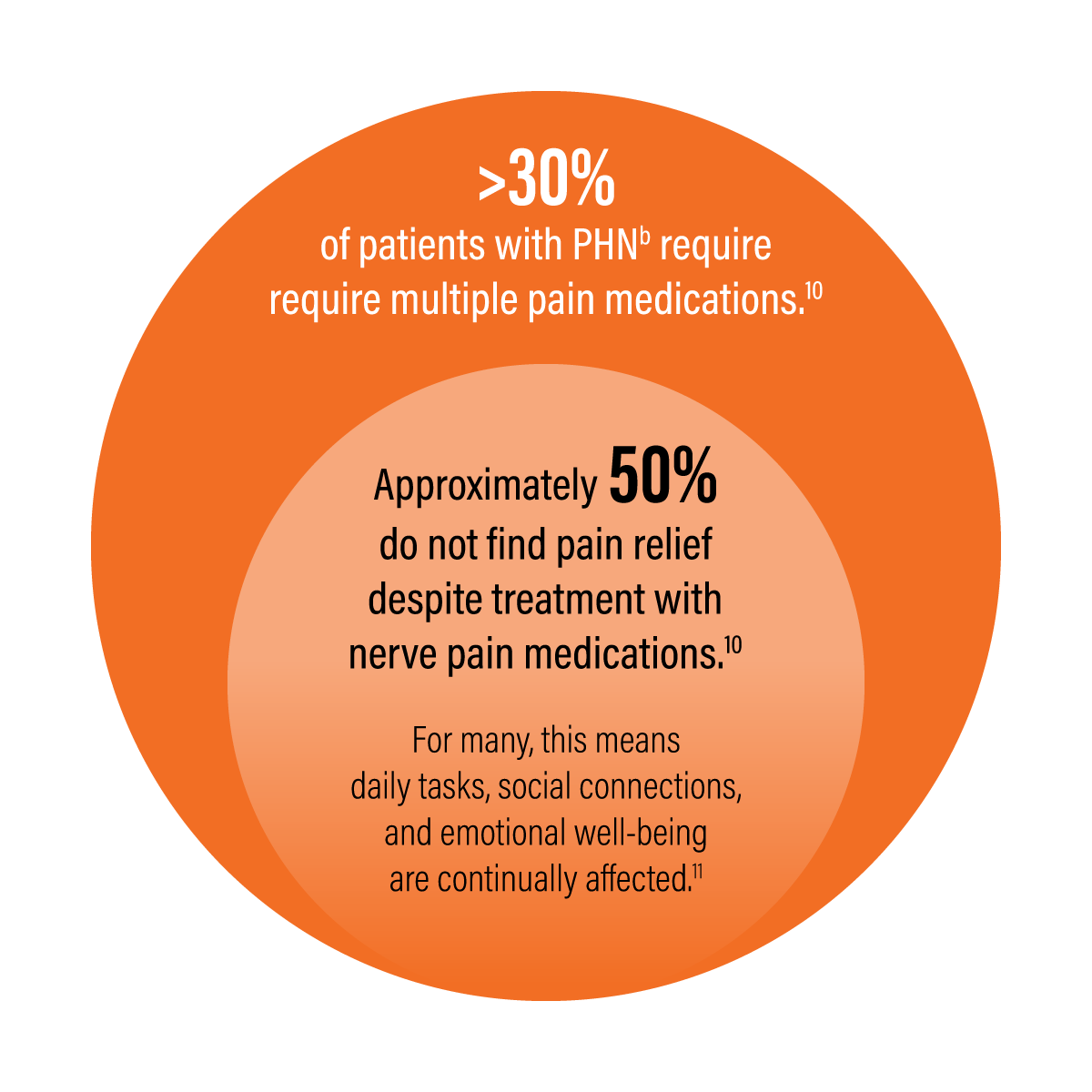
Shingles is treatable and most patients eventually recover fully. However, it is important that antiviral and pain medications are started early.1,6,8 Antivirals work best if started within 72 hours of the rash onset.1,6,8 This can be a challenge as most individuals present late to the doctor.12 Even if started early, antiviral treatment might not always reduce the risk of developing persistent nerve pain or PHN.13,14 It is not uncommon for multiple pain medications to be required to manage shingles pain or PHN, and not everyone achieves adequate pain relief.6,10
Other self-care methods to help manage shingles
It is important to consult a doctor early so that treatment can be started to reduce the duration and severity of the disease and help manage the pain.1 On top of treatment, some other self-care methods that a doctor may discuss to help manage shingles include15:
- Wear loose-fitting, natural-fiber clothing
- Apply a cool washcloth or calamine lotion to the blisters
- Cover the blisters with a new, sterile non-stick bandage to prevent infection
- Get plenty of rest and eat well
- Try and avoid stress as it might make the pain worse
Although there’s no cure for shingles, there are numerous treatments and also preventive options.1,6,8 Find out more about the prevention of shingles by clicking here.
aN=164 patients
bN=1,645 patient
- World Health Organization. Shingles (herpes zoster). Available at: https://www.who.int/news-room/fact-sheets/detail/shingles-(herpes-zoster). Accessed 17 September 2025.Centers for Disease Control and Prevention.
- Centers for Disease Control and Prevention. Shingles symptoms and complications. Available at: https://www.cdc.gov/shingles/signs-symptoms/index.html. Accessed 17 September 2025.
- Centers for Disease Control and Prevention. Shingles facts and stats. Available at: https://www.cdc.gov/shingles/data-research/index.html. Accessed 17 September 2025.
- Wang, T., et al. (2020). Quantitative proteomic analysis of human plasma using tandem mass tags to identify novel biomarkers for herpes zoster. Journal of Proteomics, 15, 103879.
- Kilgore, P.E., et al. (2003). Varicella in Americans from NHANES III: Implications for control through routine immunization. Journal of Medical Virology, 70(Suppl 1), S111–118.
- Albrecht, M.A., Levin, M.J. (2025). Treatment of herpes zoster. UpToDate. Available at: https://www.uptodate.com/contents/treatment-of-herpes-zoster. Accessed 26 September 2025.
- Goh, C. L. & Khoo, L. (1997) A retrospective study of the clinical presentation and outcome of herpes zoster in a tertiary dermatology outpatient referral clinic. International Journal Dermatology, 36, 667–672.
- Stankus, S. J., et al. (2000). Management of herpes zoster (shingles) and postherpetic neuralgia. American Family Physician, 61, 2437–2444.
- Kang, D. H., et al. (2017). Earlier treatment improves the chances of complete relief from postherpetic neuralgia. The Korean Journal of Pain, 30, 214–219.
- Sacks, G. M. (2013). Unmet need in the treatment of postherpetic neuralgia. American Journal of Managed Care, 19(Suppl 1), S207–S213.
- Oster, G., et al. (2005). Pain, medication use, and health-related quality of life in older persons with postherpetic neuralgia: Results from a population-based survey. The Journal of Pain J Pain, 6(6), 356–363.
- Fan, H. R., et al. (2023). Early diagnosis of herpes zoster neuralgia: A narrative review. Pain and Therapy, 12(4), 893–901.
- Whitley, R. J., et al. (1996). Acyclovir with and without prednisone for the treatment of herpes zoster: A randomized, placebo-controlled trial. Annals of Internal Medicine, 125, 376–383.
- Warner, D. E., et al. (2025). Low-dose valacyclovir for postherpetic neuralgia in the Zoster Eye Disease Study: A randomized clinical trial. JAMA Ophthalmology, 143(4), 277–285.
- Very Well Health. Coping With Shingles. Available at: https://www.verywellhealth.com/shingles-coping-support-and-living-well-4163772. Accessed 21 September 2025.
- GSK is not responsible for third-party website content.